
Lunapark21 is a German quarterly on political economy and its contradictions.
Critical. Independent. Since 2008.
We track conflicts, transformations, and ruptures in contemporary capitalism across labor, infrastructure, ecology, housing, war, and global power relations.
This international section is work in progress. It offers selected translations and a way to get in touch.
-

Another World Was Possible?
Seattle, Genoa, Heiligendamm: what became of the critique of globalisation, from the Tobin tax to today’s budgets. A community translation by freetranslations.foundation.
-

Workers of the World, Divide?
First Brexit, then Trump, with the same script: the redivision of the world market and the business leaders behind it.
Current
Issue 68 – Pattern Recognition: AI, Technology, Power
Artificial intelligence is not a separate “revolution”, but a set of technologies embedded in existing relations of war, labor, accumulation, and state power.
This issue follows how AI enters concrete fields of conflict, from military planning to software production and global economic competition.
Also in this issue:
- Iran and global disorder
- Afghanistan and imperial intervention histories
- Wealth taxation debates
- Feminism and working time regimes
- Land, agriculture, and ecological justice
- Energy markets and fossil dominance
Featured texts:
- A Virtual Engine of Growth?
Artificial intelligence in fictional and real accumulation
— Sebastian Gerhardt - The Tech Revolution Eats Its Children?
AI in software development between promise and constraint
— Nico Rohland - For an Independent Struggle in Iran
— Araz Bağban - Progress in Women’s Working Time?
Night work, protection and equality – a contradictory history
— Susanne Rohland

Special edition from issue 67
Housing as a Field of Conflict
Housing is not a crisis on its own, but a structured field of conflict over property, social infrastructure, and urban inequality.
It brings together questions of ownership, welfare policy, state intervention, and everyday reproduction under conditions of rising pressure.
Topics include:
- housing markets and ownership structures
- rent struggles in Berlin and legal enforcement
- public housing companies and privatization dynamics
- housing costs within social policy frameworks
- ecological and infrastructural dimensions of urban change
Featured texts:
- Which Supply? Which Demand?
Questions of ownership on the German housing market
— Sebastian Gerhardt - Option or Utopia?
The socialisation of housing companies and the dispute over compensation
— Andrej Holm - Campaign Against Excessive Rents
Organizing, enforcement, and urban conflict
— Heike Sudmann - Housing Costs and Welfare Policy
Rent, social law, and everyday precarity
— Michael Breitkopf - Public Housing Companies in Berlin
Between social mandate and market pressure
— Sebastian Gerhardt
Also in issue 67 (December 2025):
- Trump’s foreign policy strategy and the EU
- antifascist economic policy
- the 13-hour workday in Greece
- feminist debates on marriage and labor
- ports, trade, and global infrastructure
- ecological transition and heating policy
- energy markets and fossil dominance

Housing is not simply an urban issue. It is a site where finance, class relations, infrastructure, labor, ecology, and everyday life intersect under changing conditions.
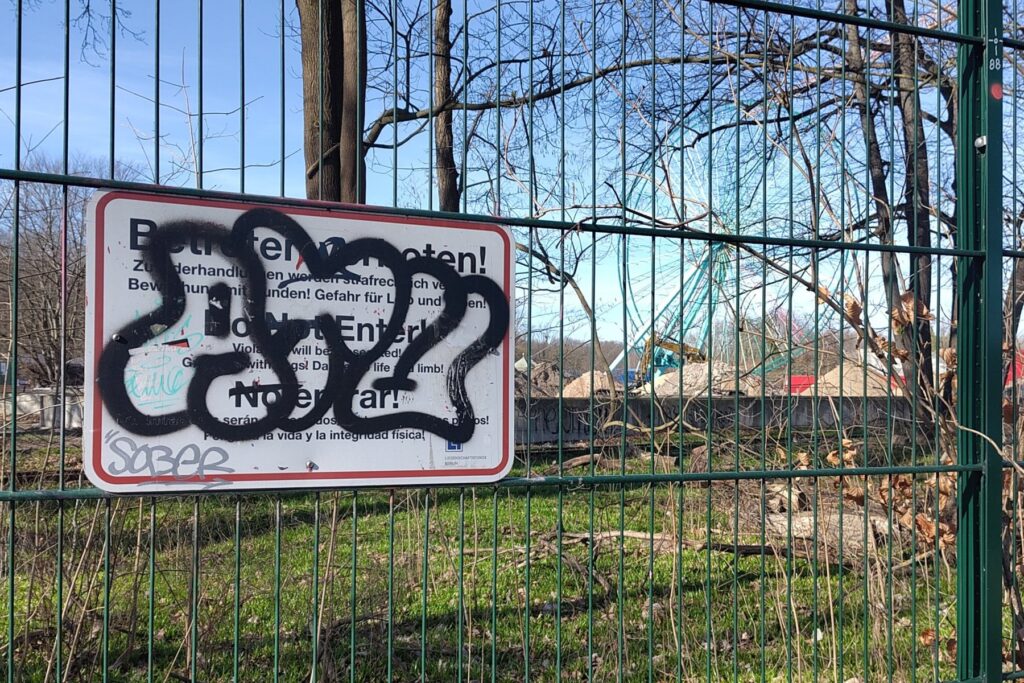
No Admittance Except on Business
Since LunaPark was founded, people have kept asking whether a name from the world of showmen, entertainers and illusions suits the weight of the subjects we cover. Today the problem looks different. Today, defending a fairground is part of the resistance against the creepy clowns who turn the really big wheel and do not want to be laughed at. That is why our rule is not “Keep out!” or “No admittance except on business.”
From the editorial of issue 68, spring 2026
✉️ Our international newsletter is in the works. For now, you can sign up here:
💬 We Translate / You Translate
This section is built on collaboration across languages and contexts.
We are looking for readers, translators, editors, and partners interested in bringing analysis into circulation beyond linguistic borders.
→ kontakt@lunapark21.net
Elsewhere
We experiment with slower forms of communication (mostly in German).
Greetings from the Crisis
A postcard once misprinted with mixed languages became a small reference point for this project.
It is kept here not as metaphor of collapse, but as a reminder that translation, error, and exchange often open unexpected conversations.
Mistranslation can be the beginning of conversation.
And conversation, in times like these, is no small thing.